

Birch Bark Processing Course (Beginner Workshop)
115,00 €
What plastic is to us today, birch bark was to people for millennia. Food stays particularly fresh and aromatic in vessels made of birch bark. Ancient cultures made use of this from time immemorial.
Date: 28 August 2015
Course duration 9:00 to 18:00 (incl. lunch break)
Location: MAMUZ Museum, Asparn/Zaya Castle, Schlossgasse 1 (near Vienna)
Management Tim Mergelsberg
Course fee plus materials (approx. €25).
Host MAMUZ Museum Centre Operations Ltd
Qualification None.
Description
Price target
On the course, you will get a solid impression of birch bark and learn about the material's unique properties. Basic knowledge of working with birch bark using various processing techniques will enable participants to continue working with birch bark independently. One to two small birch bark storage containers will be made.
Course content
In the one-day workshop, Tim Mergelsberg (sagaan) will introduce the original handicraft. Under his guidance, you will create one or two of your own small birch bark vessels, approximately 8 to 10 cm in diameter.
Historical background
What plastic is to us today, birch bark was to people for millennia. Food stays particularly fresh and aromatic in vessels made of birch bark. Ancient cultures made use of this from time immemorial.
Further information and booking the course are also possible here.
You must be logged in to post a review.
Questions & answers about birch bark tins
- regulates the moisture balance by itself and
- mould formation is thus prevented.
The birch bark box is classically round and very decorative. It is particularly suitable for serving slices of bread and biscuits in the centre of the table. It can hold a small round loaf of bread or some pastries. After eating, simply close the lid, place in the kitchen - and your bread and pastries are perfectly stored.
Your good bread stays fresh for a long time because the natural birch bark
The bark is removed in early summer harvested from living, predominantly old trees. The cambium is not damaged and the tree can continue to live. Nevertheless, it can happen that it is attacked by pests or fungi before new bark forms and then dies over the years. However, it then enriches the largely natural taiga as deadwood and makes room for higher-value species and young trees. This corresponds to the natural vegetation change. Like timber harvesting, bark utilisation is of course an intervention in the commercial forest. As individual trees in the mixed forest stand are utilised carefully, this is not ecologically problematic.
- The cans can be wiped with a damp clothbut also under the tap rinsed out if you let them dry well afterwards
- You can wash out the lunch boxes, also with vinegar water, and then place them in the oven at approx. 60°C for half an hour. This kills any mould spores and the tin can be used as before. To prevent mould growth, we recommend our Swiss stone pine grids. We enclose care instructions with every tin you buy.
- As a rule, the cans take on the flavour of the stored food, not the other way round. This can only have an effect on the flavour if low-odour food is stored for a very long time.
- No further care is necessaryrubbing with oil is expressly not recommended.
- The material used for the completely untreated, sustainable produced vessels consists of the outermost layer of the Birch barkthat we know white. In early summer, when the sap rises in the tree, the bark is easy to slit. The white layer is peeled off and the inside is golden yellow; this is used for further processing because it is more robust and durable than the outside.
- All vessels are handmade and unique.
- antiseptic (Mould formation can be prevented)
- Waterproof and robust (therefore washable)
- flavour-tightopaque
- Mothproof (Swiss stone pine wood)
- unbreakable, tight closure, trickle-proof
- light
- pH-neutral, soft and velvety like leather
They are:
- Tea, coffee (the tins are flavour-proof), herbs, spices, muesli & flour (trickle-proof), nuts, lentils, dried mushrooms
- Bread, pastries, cakes
All dry foods, e.g:
- We obtain these cans from Family businesses in Siberia (not far from the city of Tomsk), Tim Mergelsberg, the founder and managing director of sagaan, has lived in the region himself and is usually there once a year.
- We attach great importance to good social interaction and fair payment. For example, sagaan pre-financed the purchase of a family's house as a home and workshop.
- We pay attention to vegan, ecological and socially fair manufacturing processes. No chemicals are used in the entire production chain. Instead, we rely on plug-in and sewing techniques. Only individual products in the particularly flavour-tight Taiga series use some wood glue on the inside.
Related products
-

Unprocessed birch bark
24,90 € - 29,00 € Ausführung wählen Dieses Produkt weist mehrere Varianten auf. Die Optionen können auf der Produktseite gewählt werden -
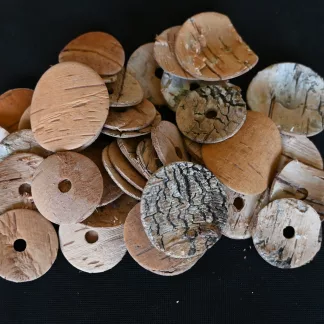
Birkenrindentaler – Plättchen für den Griffbau
29,00 € In den Warenkorb -

Birch bark blank - for making your own handles
Sale! 21,90 € - 26,90 € Ausführung wählen Dieses Produkt weist mehrere Varianten auf. Die Optionen können auf der Produktseite gewählt werden
Reviews
There are no reviews yet.