
Home / References / Decoration / Oven pipe
Warmer forest
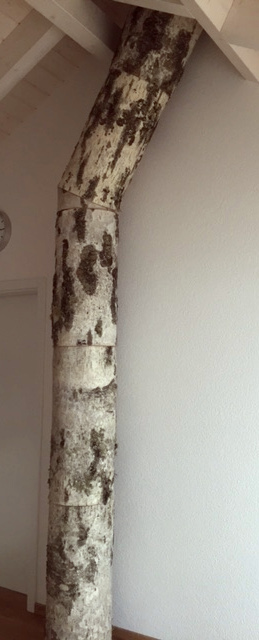
 She was looking for beautiful furnishings for her newly renovated house when she came across birch bark. But for our Swiss customer, the birch bark could do much more than just that. Keeping tea and spices fresh in tinsThe images that came to her as she looked at the birch bark were reminiscent of forest and open spaces, of the cold of winter – and of warmth. An idea was born: the stovepipe, which runs through the flat in the attic, should stand like an upright birch tree in the middle of the room.
The Swiss woman approached sagaan with this request. Pillars have already been clad with birch bark for some of our customers. But at the mention of the stovepipe, all our alarm bells rang: hardly any natural material burns as well as birch bark.
The customer then consulted a local fire safety expert. Since the chimney barely gets warmer than body temperature, he gave his „green light“. In turn, we had the flammability of birch bark tested, both before and after impregnation with fire retardants, by a well-known manufacturer of flame retardant agents and finally jointly selected suitable agents with flame-retardant properties according to DIN 4102 B1.
In public buildings, hotels, and offices, such fire protection treatments may also be required, even if they are concrete columns or similar.
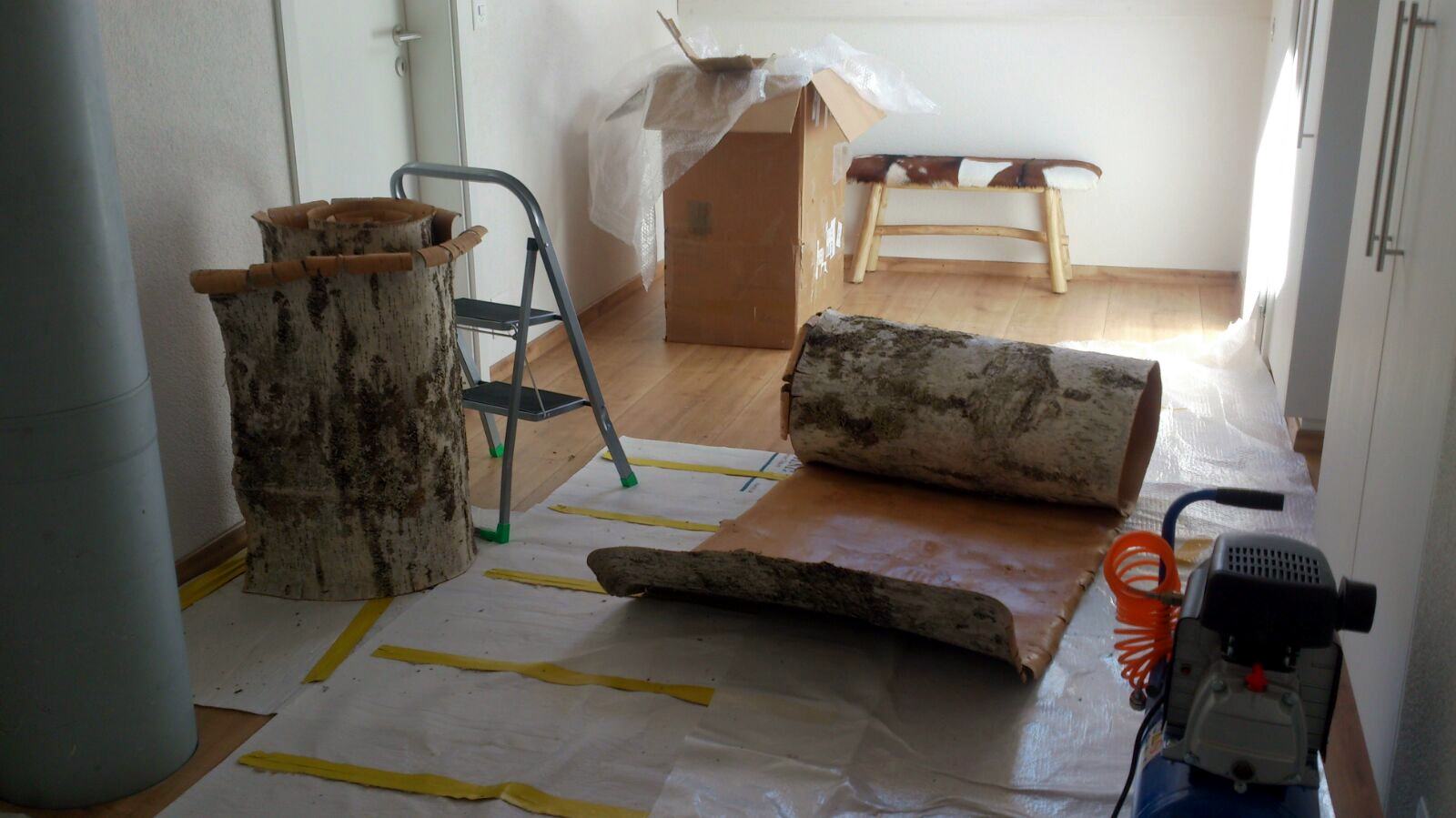
After impregnating the birch bark on both sides, we sent a 13kg package with several pieces of birch bark, up to 2.50m long, to Switzerland. Now, at last, the birch was allowed to grow out of the room. With ladders and tension belts, many hands and even more skill, a small work of art was created, and after just a few days, a proud email reached us:
 »Yesterday, we finally tackled our project and clad the stovepipe. Not everything went as we'd imagined, but we are still very pleased with the final result. We originally wanted to attach the bark panels so that the grain was represented in its natural horizontal structure. However, we feared that the bark wouldn't withstand the pressure and would tear. In the end, we decided to attach the panels horizontally because it seemed easier, and the bark was already pre-curved in that direction. There would have been seams either way, as the circumference of the pipe is quite large, and there isn't any bark that wide. It would certainly have been possible to attach the panels vertically, but in our view, that would have involved more effort and required significantly more helpers. My husband and I attached the bark together, just the two of us.
For the adhesive, we used Gomastit 2040, an elastic MS hybrid polymer sealant and adhesive. We avoided full-surface gluing, instead applying the adhesive punctually with a pneumatic cartridge gun to ensure fire protection. During the drying time, we additionally secured the bark with tension straps (lashing straps), as you can clearly see in the pictures.«
Congratulations on the stovepipe birch!
[meteor_slideshow slideshow=“ofenrohr“]
 |
 |
 |
|
 |
 |
 |
 |
|
|
 |
 |