


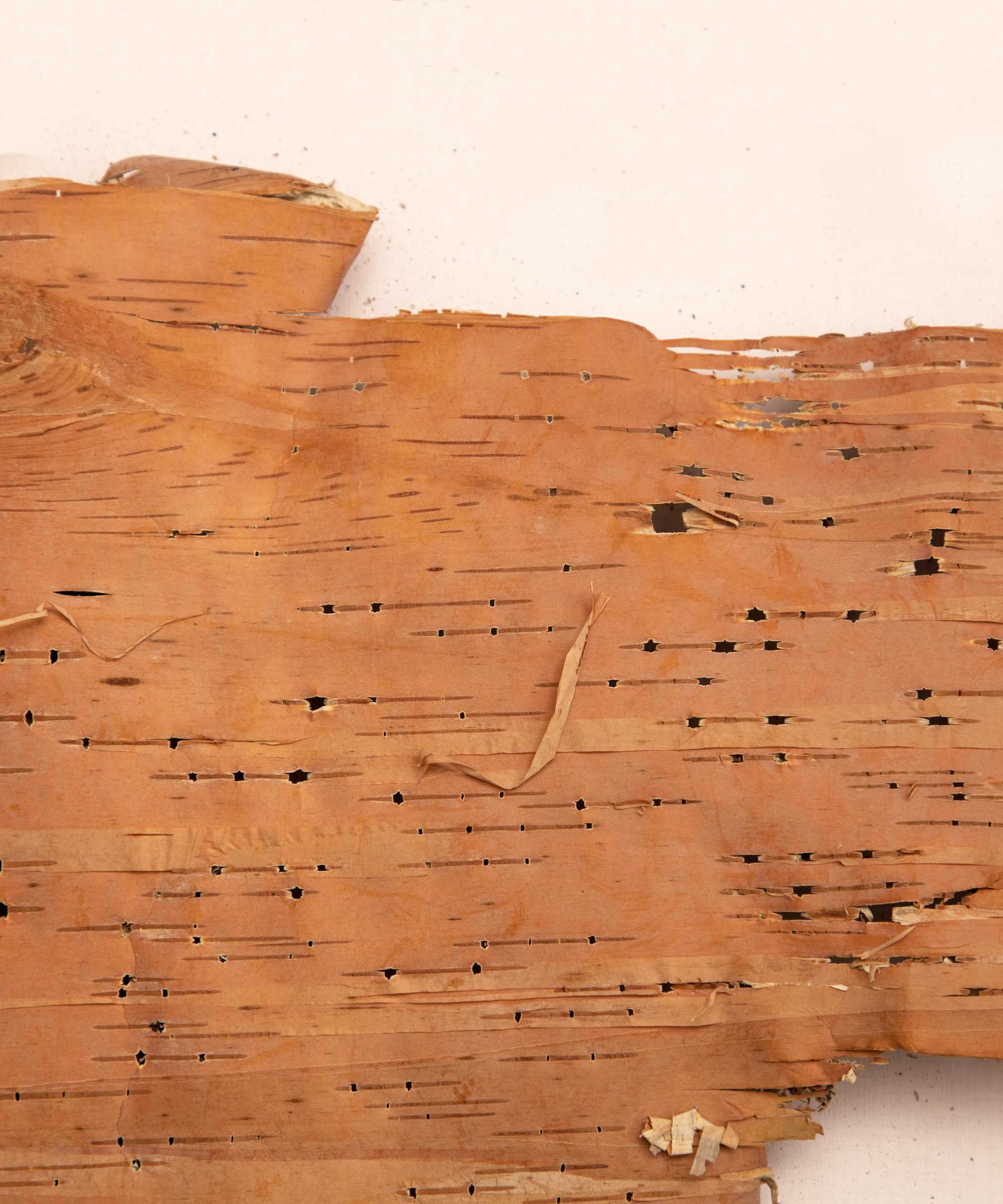

Paper made from birch bark
4,90 € - 19,90 €
This extremely thin and supple paper made from real birch bark invites you to write on it calligraphically or print on it using traditional craftsmanship! As one of the oldest paper precursors, birch bark is a very special design material.
Description
Birch bark is one of the oldest paper precursors. People have been writing on the thin layers of birch bark for centuries: The oldest documents from civilian life have been found in northern Russia: Short messages carved into birch bark with high creativity. In the northern mountain regions of India, a special script has even been developed for writing on birch bark.
Even in extreme emergency situations, such as during the First World War over a hundred years ago, many field postcards made from birch bark found their way from the front to loved ones.
sagaan offers birch bark paper in three different sizes: approx. 20x30cm (~ DIN A4), approx. 15x20cm (~ DIN A5) and approx. 10x15cm (~ DIN A6). We have painstakingly separated the individual laminar layers of the birch bark by hand to create a smooth, thin sheet that can be written on and printed on. The paper thickness is very thin at approx. 1 mm, the paper is flexible and supple. Like an onion skin, birch bark consists of many layers. The paper surface can be slightly stepped, i.e. not necessarily a single layer forms the surface. As the layers are peeled off, occasional traces of processing, e.g. scratch marks, cannot be avoided. This is evidence of a natural, lively patina.
Depending on the nature of the birch bark, small holes can naturally appear on the lenticels when the bark is peeled off thinly, as is the case with paper. The colour and direction of the lenticels (the characteristic dark lines on the birch bark) can vary.
The dimensions may vary slightly and be slightly less than the nominal value, but they are usually larger.
A small piece of birch bark paper is supplied with the sheet of birch bark paper for initial tests. The test piece does not necessarily have to be the same colour and thickness as the purchased piece.
The birch bark paper is suitable for writing and printing on, e.g. with lead typesetting and an old printing press. As a natural material, the surface is not guaranteed to be flat, so only letters that can be replaced should be used. Writing on birch bark paper is possible with a variety of writing instruments, from ink and scribing to ink writing and ballpoint pens. Not suitable for printers, copiers or similar devices.
Additional information
| Dimensions | N/A |
|---|---|
| Size |
You must be logged in to post a review.
Questions & answers about birch bark tins
- regulates the moisture balance by itself and
- mould formation is thus prevented.
The birch bark box is classically round and very decorative. It is particularly suitable for serving slices of bread and biscuits in the centre of the table. It can hold a small round loaf of bread or some pastries. After eating, simply close the lid, place in the kitchen - and your bread and pastries are perfectly stored.
Your good bread stays fresh for a long time because the natural birch bark
The bark is removed in early summer harvested from living, predominantly old trees. The cambium is not damaged and the tree can continue to live. Nevertheless, it can happen that it is attacked by pests or fungi before new bark forms and then dies over the years. However, it then enriches the largely natural taiga as deadwood and makes room for higher-value species and young trees. This corresponds to the natural vegetation change. Like timber harvesting, bark utilisation is of course an intervention in the commercial forest. As individual trees in the mixed forest stand are utilised carefully, this is not ecologically problematic.
- The cans can be wiped with a damp clothbut also under the tap rinsed out if you let them dry well afterwards
- You can wash out the lunch boxes, also with vinegar water, and then place them in the oven at approx. 60°C for half an hour. This kills any mould spores and the tin can be used as before. To prevent mould growth, we recommend our Swiss stone pine grids. We enclose care instructions with every tin you buy.
- As a rule, the cans take on the flavour of the stored food, not the other way round. This can only have an effect on the flavour if low-odour food is stored for a very long time.
- No further care is necessaryrubbing with oil is expressly not recommended.
- The material used for the completely untreated, sustainable produced vessels consists of the outermost layer of the Birch barkthat we know white. In early summer, when the sap rises in the tree, the bark is easy to slit. The white layer is peeled off and the inside is golden yellow; this is used for further processing because it is more robust and durable than the outside.
- All vessels are handmade and unique.
- antiseptic (Mould formation can be prevented)
- Waterproof and robust (therefore washable)
- flavour-tightopaque
- Mothproof (Swiss stone pine wood)
- unbreakable, tight closure, trickle-proof
- light
- pH-neutral, soft and velvety like leather
They are:
- Tea, coffee (the tins are flavour-proof), herbs, spices, muesli & flour (trickle-proof), nuts, lentils, dried mushrooms
- Bread, pastries, cakes
All dry foods, e.g:
- We obtain these cans from Family businesses in Siberia (not far from the city of Tomsk), Tim Mergelsberg, the founder and managing director of sagaan, has lived in the region himself and is usually there once a year.
- We attach great importance to good social interaction and fair payment. For example, sagaan pre-financed the purchase of a family's house as a home and workshop.
- We pay attention to vegan, ecological and socially fair manufacturing processes. No chemicals are used in the entire production chain. Instead, we rely on plug-in and sewing techniques. Only individual products in the particularly flavour-tight Taiga series use some wood glue on the inside.
Related products
-

Unprocessed birch bark
24,90 € - 29,00 € Ausführung wählen Dieses Produkt weist mehrere Varianten auf. Die Optionen können auf der Produktseite gewählt werden -
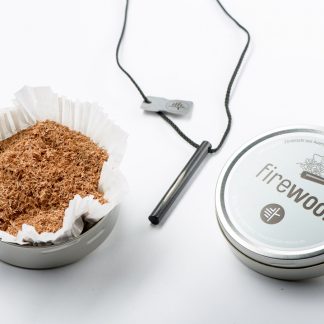
Firewool - natural firelighter with birch bark and capercaillie steel
Sale! Original price was: 25,00 €.9,99 €Current price is: 9,99 €. In den Warenkorb -
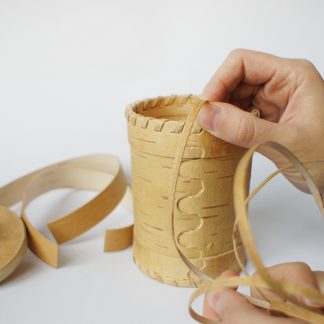
Instructions for making a tin from birch bark
0,00 € In den Warenkorb
Reviews
There are no reviews yet.