Art Basel shows art made from birch bark by sagaan
The young artist Monilola Olayemi Ilupeju enchants birch bark into a work of art that sensitively interweaves her personal life story with the great questions of humanity.
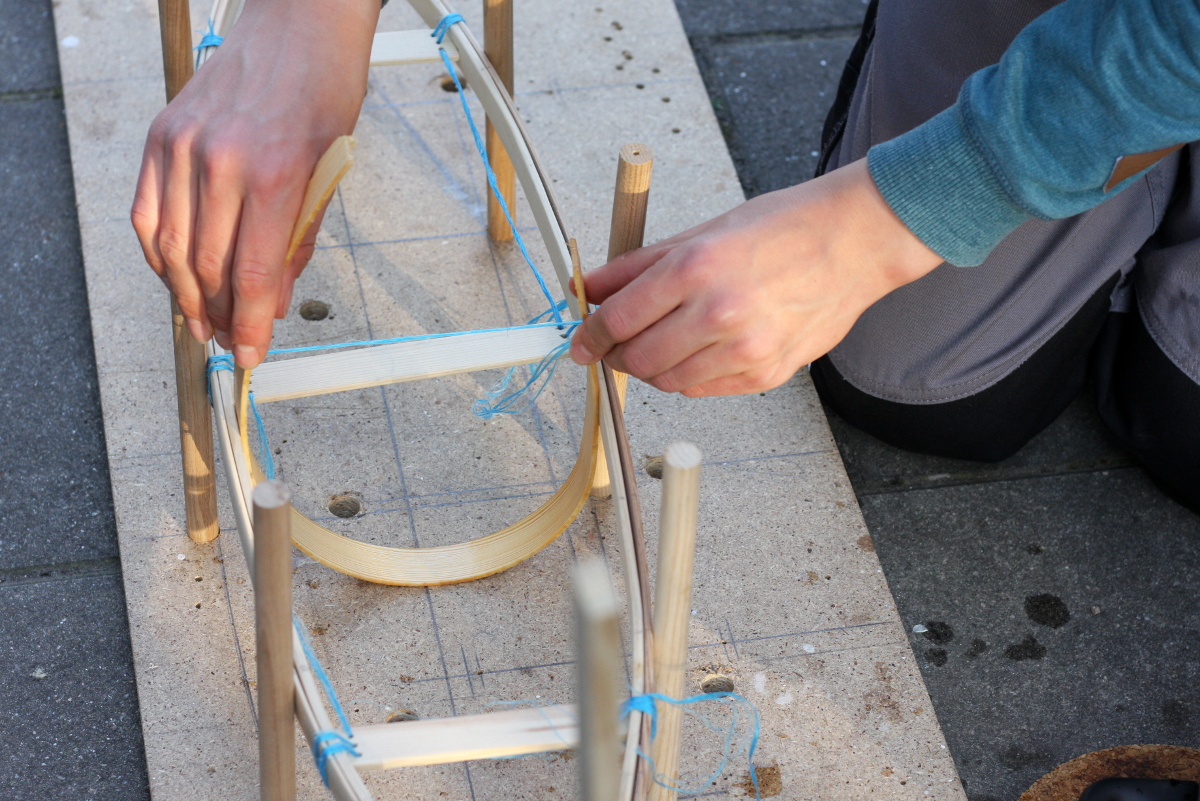
In the thick of the development process: Tim Mergelsberg from sagaan.
The tree with birch bark skin was designed in sagaan’s studio in 2025 and jointly realized by hand.
The Wishing Well, 2025, Monilola Olayemi Ilupeju
The Wishing Well begins with a personal memory of a fallen birch tree, reimagined as a vessel that probes materiality and the enduring myth of purity often projected onto nature. Long regarded in the West as a symbol of innocence and sublime beauty, the birch here is recast as a porous, hybrid body shaped by contamination, entanglement, and multiplicity.
Reflecting on the tree’s culturally saturated history, from European Romanticism and nationalist iconography to the Indigenous practices of the Anishinaabe and the Sámi, the work refuses singular meaning. The birch becomes an emptied monument; a spectral void where histories, memories, and bodies intermingle, mutate, and come undone.
Constructed from two hollow plywood forms clad in a patchwork of sustainably harvested bark from Siberian forests and remnants of fallen German trees, the work exudes a Frankenstinian charm. Graphite scribbles, oil pastel, charcoal powder, and pyrographic inscriptions akin to asemic writing—a wordless, open semantic form of script—dissolve into the bark’s paper-like skin. Earrings and shards of a personal body mirror glint across the surface like betulin, the crystalline compound responsible for the birch’s luminous, heat resistant sheen. Through this meticulous intervention, the bark becomes a site of concealment and revelation, destabilizing the tree’s symbolic legibility and prompting a closer look. The Wishing Well is thus a site of unmaking, inviting us to consider what remains when structures of meaning are hollowed out.
The birch’s Proto-Indo-European etymology bherə-, “to shine” or “to be white” hints at a long entanglement with notions of purity and progress. In Romantic landscape painting and literature, the tree’s slender, pale trunk was often feminized and racialized, reinforcing gendered essentialisms around fertility and domesticity, as well as naturalizing ideals of whiteness. As Europe industrialized, this imagery was swiftly folded into various nationalist projects, eventually making the birch the national tree of Finland, Russia, and Sweden, while retaining deep cultural resonance across the continent.
In some Indigenous worldviews in North America and Scandinavia, the birch is not only a symbol, but also a collaborator; a being whose bark becomes baskets, tinctures, flour, and canoes, and whose vitality is honoured through practices of reciprocal care. From this vantage point, the birch’s Western ecological classification as a “colonizer” or “pioneer” species due to its rapid growth is reframed, not as an agent of domination, but of renewal in disturbed ecosystems. Here, survival is collaborative, not competitive; contamination is not decay, but transmutation. The Wishing Well channels this ethic, offering a poetics of disassembly.
The installation also features a carved tree stump that doubles as an interactive mancala board, complete with 48 handmade ceramic beads—a tribute to a beloved game from childhood. Broken breezeblocks from a previous installation and mirror fragments quietly accumulate in the tree’s hollow like coins at the bottom of a well. Oil paintings rendered on birch bark depict conjoined landscapes of fragmented bodies and water bodies bordered by nations with deep cultural ties to the tree. And just out of the frame, a poem faintly hums.
Amid the fair’s spectacle, The Wishing Well reads as both an elegy and an invocation. A fractured tree carcass singed in charcoal and strewn across white bathroom tiles inevitably conjures an uncanny vision of total environmental collapse. The birch here is not pure, not sanctified; it is wounded, interdependent, and clinging to life. In a world obsessed with borders, clarity and control, the project insists that the most generative forms of beauty and survival emerge from muddied waters.
— Monilola Olayemi Ilupeju, 2025

Contribution sagaan:
- Provision of bark for preliminary tests 2024
- Consulting in the conception phase
- Support in planning the technical implementation: construction of a hollow body as an imitation tree with birch bark sheathing
- Joint technical implementation in the sagaan studio, Görlitz, Germany
- Logistics
- Advice and support with technical questions until completion


The birch as a receptacle for the sweat of our desires.
The birch as an oracle, harbinger of a new past, recordkeeper of the dying days.
The birch as a tabula inscripta lovers and children carve their sticky initials into.
The birch as pioneer, suffusing all the scorched earth with its spinning seed.
The birch as ancestor, shedding its skin in sheets for baskets, canoes, and letters to the young.
The birch as a sorceress, boiling tinctures in her bosom.
The birch as a crystal-coated seductress.
The birch as an ecological darling.
The birch as a whiteness that can never get clean and so rots from the inside out.
The birch as a politician, gerrymandering its root system into the shape of a prison.
The birch as a slain soldier, bleeding sweet medicinal sap.
The birch as a dom, signing its autograph on cherry cheeks.
The birch as your plaything.
The birch—berk, berkōn, bark, birk, bjørk, berHǵ -, béržas, Bērzs, берёза (berëza), bredh (“fir”), bærz(æ), bhurja,
brzoza—as a lesson in unlanguage.
The birch as tar-glue, smearer of borders.
The birch as an oil-slick mirror, licking the sun and spitting its flares back into the atmosphere.
The birch as a flurry of bisexual inflorescences, fluorescent, charming, anarchic in essence.
The birch as the measure of one human life: eighty years of sunsets falling at its trunk.
The birch as a deathless thing, a many-limbed martyr, scattering its fungal remains like ashes across
the small meadow we used to visit.
The birch as a pregnant stomach rolling down a field of honeysuckles.
The birch as a baby on a bed of freshly sheared wool.
The birch as the voice that coos you to sleep.
The birch as a funeral procession on a perfect, cloudless blue day.
The birch as muse.
The birch as God.
The birch as a tree.
The birch as a wishing well.